

Therapy as Grief Work
/Written by Concentric Counselor Christian Younginer, LCPC, NCC
“All therapy is grief work.” - Dr. Edith Eger
On a Friday morning, I am confronted with the pesky truth of Dr Eger’s thought. A Holocaust survivor, her words hold an even deeper pain and meaning that I could ever know. Her story, neither mine to tell nor able to ignore, drives me to know what she means by this thought.
I have my own therapy on Friday mornings. The time of the week when I sit with the discomfort of my own feelings. The time I practice what I preach, to varying levels of success. I enter into the comedically recursive loop of therapists who see therapists. I wonder if there is a grand therapist above all. Perhaps one who knows, better than anyone, that ‘all therapy is grief work’ and can help me cope with this idea.
All therapy is grief work because loss is inherent in living.
We grieve all losses, not just lost loved ones. We grieve for freedom, career, our country, our childhood, changes, friendships, choice, people we’ve never met, what never was, what never could be, and what always will be- to name only a few. While successes, gains, and wins are just as much a part of living, I will hold them to the side for the time being.
Grieving the loss of things we never had or things that could never be isn’t something we talk much about. In fact, it can come as a shock to clients when the word ‘grief’ enters the therapy space. ‘It’s not like someone died!’, they may say. True, but maybe something did die when you lost that job or learned the news of your partner’s illness. Maybe it was choice, or agency, or familiarity, or certainty. Those deserve grieving. They are the currency of a meaningful life and grief reconciles our accounts.
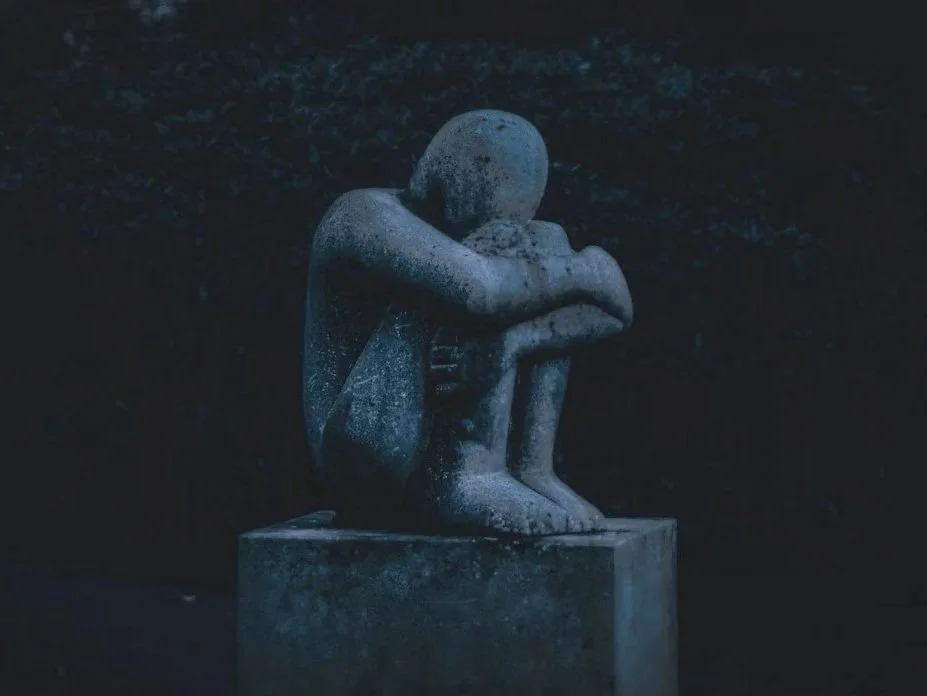
Loss - A sculpture by Jane Mortimer
To return to my individual therapy session, I was sitting in the prickly truth that some things may never happen and still worse, some things just can’t. Things I want to happen or wish could. The gall of existence. The audacity to show us time and again that despite how firmly we take the wheel, it was never really connected to the tires. Like a toddler’s toy car, we’re not controlling anything, but it sure is fun to honk the horn. I think of Buddhists. Suffering comes from desire, they say. Am I too desiring? Should I not want things? That seems extreme. Anyway, I’m not a Buddhist. I don’t like the word surrender. Is that the answer? It’s an answer, my therapist says, following with questions about my answer. Like a jigsaw puzzle, it’s not about having the pretty picture. So I work through the process of finding pieces that fit and setting aside the ones that don’t.
I do this by examining what I’ve lost. Unearthing what could have been, but didn’t happen. Giving it permission to exist in the working spaces of the mind, not the cobwebbed corners where we dismiss the things that seem irrelevant. Grief is always relevant. It is how we cope with the whims of life. So I wade through the tar of ‘if only’, finding that although it is difficult, my feet do touch the bottom. Difficult and churning, but neither endless nor swallowing. “I can wade grief”. From ‘if only’, I slowly move toward the shores of ‘and yet…’
Like a sunny January day, grief is cold and beautiful. It’s an agonizing honor. Imagine living a life to minimize grief. How little we’d do, or love, or attach to. Grief is the privilege of having known something or someone so deeply that we struggle to see life without them as living. In fact, that pain of the loss may be all we have left of them. Please don’t take my sunshine away.
Like everything else precious or beautiful, productivity culture tells us to knock it off. Statements like ‘what good does that do’ shame us from ever exploring our grief. God forbid we pause and feel our existence for a moment. Like bereavement for a loved one, we may need time to feel through the complexities of any loss. Time to integrate the change. This can only happen if we let ourselves acknowledge and accept it through discussing it, understanding it, and making room for it in our lives.
So I sat there in therapy, pissed off that the steering wheel was never connected to anything. I had to acknowledge the barest truth of existence. The one that death and loss jams in our face every time. I will never be in as much control as I wish to be. Take death, the great unraveler itself. When we experience a death, it is nigh offensive that someone so important is taken from us. That they could be! The same is true for all constructs of a meaningful existence. When we face the indifference of life’s pendulum swing, we embody the courage to live despite it. Maybe I need to chew on the word ‘surrender’ more.
‘All therapy is grief work’ because I will never be in control as much as we wish to be. However, through facing this grief, I can recalibrate, reorient, and point my toy car in the right direction, even if I can’t steer it as much as I’d like.
Want to explore more writing from our Concentric counselors? Take a moment with this piece by Jennifer Larson, LCPC, NCC, Founder of Concentric: Understanding Grief and Loss and How Healing Begins. It’s a thoughtful reflection on how we experience grief, what healing can look like, and the gentle steps that help us move forward.
About Concentric Counseling & Consulting:
Concentric is a mental health group practice offering individual therapy, couples and relationship counseling, tween and adolescent support, family therapy, couples intensives, and consulting and supervision services. Our therapists work with a wide range of concerns, some of which include anxiety, depression, mood-related challenges, complex and developmental trauma (C‑PTSD), relationship and family difficulties, school and peer issues, relational trauma, mind–body connection, life transitions, acute and chronic stress, grief and loss, identity and purpose exploration, substance misuse, and unresolved family‑of‑origin experiences.
Many of our clinicians and therapists also bring additional areas of specialization, which you can explore on their individual bios.
We provide care 7 days a week, with in‑person sessions available at our Chicago offices in The Loop and Sauganash neighborhoods, as well as virtual teletherapy for added flexibility.
Services offered in English, Spanish (Español), Romanian (românǎ), and basic KOREAN (한글)
If you are ready to learn more or get started with us, please reach out to us here.