

The Inner Dictator: How Our Inner Critic Controls Us
/By Concentric Therapist Christian Younginer, LCPC, NCC
‘Silencing Your Inner Critic’, at this point, has become a therapy cliche. Article after article giving ways to beat the inner critic and unleash your true self. The inner critic is so ubiquitous probably because it’s so relatable. Hell, my inner critic had a hand in these opening sentences. I was worried that writing this piece is a cliche in and of itself. So I had to address the cliché upfront to let you know I’m on the up-and-up. That little nugget of vulnerability notwithstanding, I’m going to soldier on and attempt to bring forward a possible new way of seeing the inner critic that is unfortunately relevant to our current state of affairs in the US. Perhaps we can ignite some outrage and push back against the internalized authoritarian that rules our brains with an iron fist.
Rather than ‘silencing’ the inner critic, what if we ‘overthrow’ the critic? Staged a coup against it. Pushed back and fought it with choice and agency. We’re all susceptible to internal and external manipulation. Perhaps by seeing how it came to power, examining its tools for remaining in power, we can dismantle the dictator that lives between our ears.
A Little Learning First:
I will be using language from both Gestalt and IFS (Internal Family Systems) therapies to help lay out this framework. A quick refresher on both modalities:.
Gestalt is a German loanword that means a whole, made up of parts, that is greater than the sum of those parts. Pizza is a gestalt. Pizza, made up of parts, is greater than the sum of cheese, sauce, and dough. Pizza has taken on a greater form and meaning than just cheese, sauce, and dough. A person is a gestalt. There is more to a person than flesh and bone, career and status. The therapy based on this concept looks like examining the parts of that whole, understanding that which comprises the whole, and working to honor that whole that those parts create. I’m oversimplifying for the sake of brevity.
IFS (Internal Family Systems) is a modality that examines these parts of a person, and determines the ‘jobs’ of these parts. What they do for us, how they help or hinder us, how they interact with each other, and when they were formed. Again, I’m oversimplifying, but this should do.
The important piece here is that we understand the concept of a ‘part’. Many may already think of themselves in this way. One might say, “Part of me wants to go on the trip, but another part is worried about the money.” You understand parts now.
We are going to view the inner critic as a part. It is a part that makes up the wonderfully complex system that moves us through the world. Making decisions, acting, and striving for the life we want. This part is sometimes viewed as something worth silencing. To counteract its sway that leads us to second-guessing, doubt, and timidity. I suggest we see it for what it is and overthrow it.
It is a fear-mongering despot, desperate for control in a world it is so afraid of that it would tell you to freeze rather than act. So afraid of what might be, it would rather you never stray into the risk of what could be. An insecure toddler desperate to trade choice for certainty, at your expense. It preys on the hope you’re just as afraid as it is. That you’re seeking relief from a world too diverse, complex, and unknown that you’d believe it and follow along if it could just stop the fear for a moment. For examples of this behavior, consult your local newspaper.
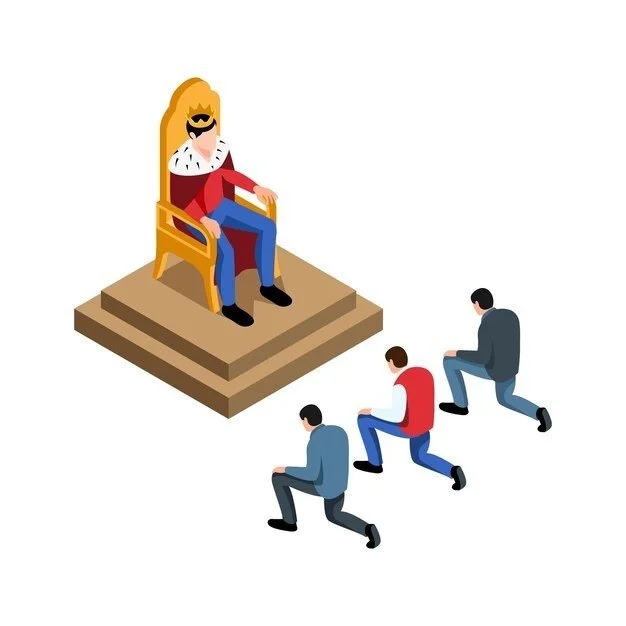
FREE IMAGE COURTESY OF macrovector VIA MAGNIFIC
With fascist behaviors such as these, there is always a boogeyman. This boogeyman is often immigrants, marginalized groups, or any other objectified threat to keep you scared. It says: look at all these bad things happening in your world, it must be caused by this thing you don’t understand and don’t want to. I will protect you from this thing if you just follow me and I will tell you the world is safe and in your control. You don’t have to adapt and learn and grow, you can live in the bubble with me. I will tell you all the lies you want to hear so you feel safe.
The boogeyman that our inner critic so often manufactures is the dirtiest of all f-words: failure. The inner critic weaponizes failure to be both the thing that will be our downfall and the thing it will protect us from. All we have to do is buy-in.
Buying-in is simple: just don’t try. As Homer Simpson once said, “Trying is the first step toward failure.” Can’t fail if you don’t try. So the inner critic pokes holes in your idea until it falls apart. It doubts whether this job switch is a good idea. It whispers comforting lies that you ‘didn’t really want to do that thing anyway’. Forever saving face, rather than facing the truth that sometimes it doesn’t work out, and you still should’ve tried anyway.
Fear-mongering masquerading as protection is a core engine of authoritarianism, and unfortunately we’re susceptible to it even within our own inner world. The inner critic believes it is protecting you from failure, when it is actually harming you in so many other ways. It strips you of confidence, of self-efficacy, of power, all in the name of trying to protect you from what it believes will destroy you. But there’s something it doesn’t know…
You are stronger than you think you are.
Failure won’t destroy you. In fact, failure is always an option. Failure leads to all those things the dictator doesn’t want you to do: learn, improve, grow, and succeed despite the world being terrifying to him. The inner critic is scared, but you don’t have to be. You possess the courage it lacks. Courage to do the thing, to try and fail, and do it again.
From this perspective, perhaps we can dismantle our inner critic with the same tools we use to, at least intellectually, fight authoritarianism: acceptance, understanding, and kindness.
Acceptance that you may fail if you try. You may look foolish, make a mistake, feel the sting of hindsight, etc. Radical acceptance leads to growth. It fuels the engine of change by resetting expectations to work with the world rather than in spite of it. Acceptance frees us from rigidity and lends strength through flexibility.
Rigid things aren’t strong, they’re brittle.
Understanding that growth comes from doing the hard thing. Challenging preconceived notions, questioning the way you’ve always done things, learning that you are allowed to be wrong. The inner-dictator wishes you don’t change. That would put you in danger of the unfamiliar. Curiosity fuels learning. Learning leads to expansion.
Expansion makes room for both success and failure.
Kindness tells us that it is ok to fail. In fact, it’s part of being human. Kindness gives us the grace to try again. Like a child riding their bike for the first time, the kindness in-between falls ensures there is another attempt. The inner-dictator believes that a football coach gets better results than a teacher. Gentle support fuels courage in the face of failure. Being harsh with oneself fuels internal resentment and giving up.
Courage leads to trying.
If I may be honest, I faced a fair amount of internal criticism in writing this. It didn’t turn out as I’d hoped. I thought the analogy felt ham-fisted and tenuous. But here I am writing anyway. Perhaps after it’s live, I’ll have a new thought and can come back to amend it. Regardless, I want to live through the words I’ve written here and try it anyway.
I wish to rebel against my internal voice that tells me to toss the idea and start over. That brutalizes me with fear. The inner-dictator, and the one screaming in the news, would have us believe we’re in danger from everything and everyone else, except for him. Screw that. Instead, I will embrace acceptance, understanding, and kindness and do the hard thing. Because if it even helped one person, it was worth trying.
¹A brief aside on control: Humans suck at control. As an Existentialist, I believe our desire for control is the unhealable wound of existing, and dying, without our consent. We spend our lives desperately clawing for control over our world, and the worlds of those we care about. Seeking to shield ourselves from the truth that we’re never in as much control as we want, we cling to clocks, schedules, power, money.. When we’re challenged by new thoughts, new information, new data we can choose to lean into that discomfort and grow with it, or cower under what we’ve always known and call it truth. Inclusivity, acceptance, growth, and education are hard. They ask us to feel out of control for a bit before we can build a new foundation of which we can build. It forces us to change our internal definitions, rebuild, and maybe even challenge parts of our identity. All scary stuff to a human who just wants to believe they understand how the world works.
See Petru Ilie’s wonderful piece on change.
About Concentric Counseling & Consulting
Concentric is a mental health group practice offering individual therapy, couples and relationship counseling, tween and adolescent support, family therapy, couples intensives, and consulting and supervision services. Our therapists work with a wide range of concerns, some of which include anxiety, depression, mood-related challenges, complex and developmental trauma (C‑PTSD), relationship and family difficulties, school and peer issues, relational trauma, mind–body connection, life transitions, acute and chronic stress, grief and loss, identity and purpose exploration, substance misuse, and unresolved family‑of‑origin experiences.
Many of our clinicians and therapists also bring additional areas of specialization, which you can explore on their individual bios.
We provide care 7 days a week, with in‑person sessions available at our Chicago offices in The Loop and Sauganash neighborhoods, as well as virtual teletherapy for added flexibility.
Services offered in English, Spanish (Español), Romanian (românǎ), MANDARIN (普通话), and basic KOREAN (한글)
If you are ready to learn more or get started with us, please reach out to us here.