
When Life Refuses to Change: Choice and Meaning
/By Concentric Therapist Petru Ilie, LPC, NCC
There are moments in life when the world refuses to bend. A diagnosis arrives. A relationship ends. A job disappears. A loved one’s choice breaks our heart. A season of life shifts in a way we never asked for.
And in those moments, something inside us whispers a familiar plea: “I just want this to be different.” But it isn’t, despite how much we wish and pray. The situation will not change, no matter how hard we push, negotiate, analyze, hope, or manifest.
It’s in these moments that Viktor Frankl, psychiatrist, Holocaust survivor, and founder of logotherapy, offers a line that has echoed across decades:
“When we are no longer able to change a situation, we are challenged to change ourselves.”
It’s a message that can feel comforting, confronting, confusing, or angering depending on where you are in your life. But it’s also an invitation to a different kind of strength, one rooted in something other than control: meaning.
Let’s explore what Frankl might have meant, why it matters, and how we can begin to live this truth in a grounded, compassionate way. As a therapist working from a humanist, existential, relational framework, I see this quote come alive in the therapy room every day.
The Weight of What We Cannot Change
There’s a particular heaviness that comes from facing something immovable. It might be external: a loss, a limitation, or a circumstance. Or internal: a chronic condition, a personality trait, a history that can’t be rewritten.
When people come to therapy seeking support for anxiety, depression, trauma, stress, or life transitions, they often arrive with a quiet hope: “Maybe if I understand this enough, or if I do something different, I can make it go away.”
But some realities defy understanding and can’t go away. And that’s not a failure; it’s part of being human. Frankl acknowledges a simple truth: There are limits to what we can control. Big, insurmountable limits. And when we reach those limits, something else becomes possible.
Choice: The Ever-Present Reality
Frankl wrote these words in his book, Man’s Search for Meaning, while reflecting on his time as a captive in Nazi concentration camps. He witnessed pain at the hands of a merciless existence on a scale that defies comprehension. Yet he noticed something profound: even when everything is taken away, a person still has the freedom to choose their attitude, their response, their inner stance.
Frankl believed that meaning can be experienced even in hardship, not because hardship is good, but because humans have the capacity to respond with intention and purpose. This is different from toxic positivity, or just pretending things are fine when they’re not. It’s reclaiming the last realm of human freedom: the ability to choose how we meet what we cannot change. In therapy terms, this is the heart of existential resilience: the capacity to stay connected to meaning, values, and agency even in the face of pain or an absurd, merciless, existence.
The Misunderstanding: “Just Change Yourself”
Frankl’s quote is often misunderstood as a kind of self-help command: “If you can’t change the situation, just change yourself, you’re the problem.” But that’s not what he meant. He wasn’t telling people to “fix” themselves. He wasn’t suggesting that suffering is a personal failure.
He was pointing to something gentler, deeper: When the world won’t shift, we can shift the way we relate to it. We can grow in ways we didn’t expect. We can experience meaning in places we never thought to look. It’s self-liberation rather than self-blame.
In an existential, humanist, person-centered therapy approach, the goal isn’t to “change yourself” in the sense of becoming someone different. You’re not a problem to be solved. It’s about becoming more fully yourself, more aligned with your values, more connected to your inner agency, more grounded in truth as it resonates with yourself.
Frankl’s quote is about self-relationship, not self-improvement. It’s about how you meet yourself in the moments when life feels unchangeable. You can’t help who the world is to you, but you can choose who to be to yourself and to the world. Sometimes the shift is subtle: From self-criticism to self-compassion. From avoidance to presence. From rigidity to flexibility. From judgment to curiosity. From isolation to connection.
These shifts may seem small, but they can reshape the way you experience your life. Many people come to therapy feeling stuck in unhealthy patterns, toxic relationships, overpowering emotions, or oppressive circumstances. Part of the work is exploring what is yours to change and what isn’t. When something truly cannot change, the question becomes: How do I live with this in a way that honors who I am?
This is where mindfulness-based therapy, values-based living, and existential exploration intersect, asking questions like: What matters most to you? What kind of person do you want to be? What choices are available, even in pain and hardship? What meaning can you create? Living this way is reclamation rather than resignation.
The Difference Between Acceptance and Giving Up
Acceptance is often misunderstood as passivity. But in therapeutic work, acceptance is an active, courageous stance. It is the willingness to acknowledge reality as it is, without sugarcoating it or collapsing into despair. Acceptance says: “This is the situation I’m facing. I don’t have to like it. But I can choose how I respond.”
Frankl invites us to bravely face the direness of our situation and ask: What is outside my control, and what is within my control? How can I exercise my freedom to let go of what isn’t mine? Then I’ll be free to really take charge of what is.
These questions aren’t easy. They require honesty, courage, and often grief. But they also open the door to something powerful: choice. While choice doesn’t erase pain, it can transform helplessness into meaningful agency.
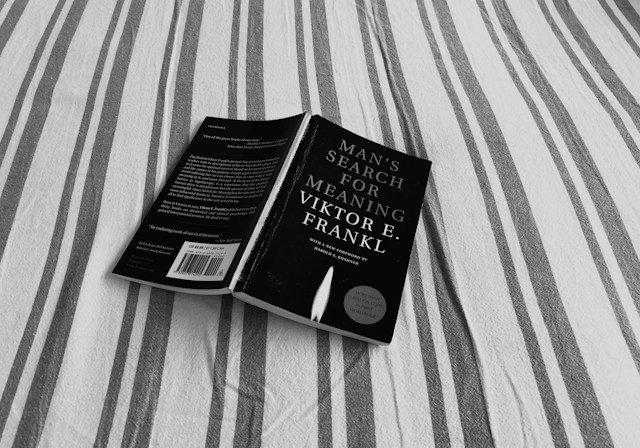
Image courtesy of pop & zebra unsplash (free image)
Choice: Three Pathways of Inner Change
Frankl’s thought points toward several forms of inner transformation. When we can’t change the world, here are some aspects of inward change we can choose:
1. Changing Our Relationship to Pain
Pain is part of being human and often unavoidable. Suffering, on the other hand, often comes from the stories we tell about that pain. We can amplify pain or ameliorate it through how we regard it. One such story about pain we often tell ourselves is that we can’t tolerate it. Then our distress increases not just because we are in pain, but more so because we think it will overwhelm us and we can’t endure it. When in fact we may be more resilient than we think. When we soften our stance toward discomfort through mindfulness or compassion, the pain could become more bearable. It could stop being an adversary and may become something we can sit with. And when we accept it (since we can’t change it anyway), we may free up our emotional and mental resources to make other choices toward aspects we can actually change. Acceptance can be the path to change, not its obstacle.
2. Changing Our Perspective
Perspective doesn’t erase reality, but it reframes it. Far from gaslighting ourselves, reframing and changing our perspective can actually broaden our horizon, not limit it. It’s like choosing to take off your sunglasses in a dark room with a broken light. It’s not that it turns on the light if you take off the glasses, that useless bulb is still broken. But you may be able to navigate the darkness a tiny bit more clearly, with slightly lifted shadows. Plus, why keep your view of the room darker than it needs to be? Sometimes the shift is small: from “Why is this happening to me?” to “What does this ask of me?” Or from “I’m powerless.” To “I still have some agency, even if it’s just internal.”
3. Changing Our Actions
Even when circumstances are fixed, our actions may not be. And even when we feel stuck internally, we may still be able to do one thing or another externally. For instance, we can’t help feeling angry. But we may choose not to act violently in our anger. Or we can’t help feeling sad. But we may choose not to act self-destructively in our sadness. Or we can’t help the thought of despair that’s in our head. But we may choose to relate to it as just a thought (one of many thoughts), and not as the totality of truth.
Then we can act according to our values instead of our instinctive overwhelming emotions or unhelpful thoughts. We may discover choices like setting boundaries, reaching out for support, resting, speaking honestly, grieving, or starting fresh with a new day. Not all these choices may be available to us; but others might. It may take exercising creative courage to look for agency. And choices accumulate. They shape a life and create meaning.
Choice Creates Meaning
Frankl believed that humans can endure almost anything if we can experience meaning in it. Meaning doesn’t justify suffering. It doesn’t make it OK. But it can make it survivable and sometimes transformative.
Meaning is hard to define, but I like to think of it as this ambiguous conviction of worthwhileness that can come from realities like relationships, creativity, service, faith, growth, integrity, or love. If something is meaningful, it is somehow worthwhile through the pain, and it resonates with our values. Not that the pain is inherently "worth it,” but that there can be something else worthwhile in this experience.
Conceptualized this way, meaning may not even be something you seek or discover. Instead, the experience of meaning may be something you create through the choices you make and the way you show up in the world. Whether something is inherently meaningful or not is for the philosophers to debate. Either way, what seems to be experientially true is that something can be meaningful to you based on how you choose to relate to it. And something in the human spirit resonates with that.
A Gentle Practice: Meeting the Unchangeable
Here’s a simple reflection you can try when you’re facing something you cannot change:
Name the reality. What is the situation you’re facing?
Name what’s outside your control. What cannot be changed, no matter how hard you try?
Name what’s inside your control. What choices, however small, are still available to you?
Name your values. Who do you want to be at this moment?
Take one small action to live meaningfully through this. Something that reflects your values, whether an external action or an internal action, even in the midst of difficulty.
Want to Explore Frankl’s Work?
If you’d like to read more of Viktor Frankl’s reflections, Man’s Search for Meaning remains one of the most influential psychological works of the last century. You can also explore a brief overview of logotherapy through the Viktor Frankl Institute.
And if you’re curious about how therapy can support you in navigating situations you can’t change, you can learn more about my approach on my bio.
Life will always have moments we can’t control. Within those moments, we still have choices. Choices about how we show up, how we care for ourselves, how we relate to our pain, how we engage with the world, and how we create meaning. When the world will not shift, we can shift the way we meet it.
About Concentric Counseling & Consulting
Concentric is a mental health group practice offering individual therapy, couples and relationship counseling, tween and adolescent support, family therapy, couples intensives, and consulting and supervision services. Our therapists work with a wide range of concerns, some of which include anxiety, depression, mood-related challenges, complex and developmental trauma (C‑PTSD), relationship and family difficulties, school and peer issues, relational trauma, mind–body connection, life transitions, acute and chronic stress, grief and loss, identity and purpose exploration, substance misuse, and unresolved family‑of‑origin experiences.
Many of our clinicians and therapists also bring additional areas of specialization, which you can explore on their individual bios.
We provide care 7 days a week, with in‑person sessions available at our Chicago offices in The Loop and Sauganash neighborhoods, as well as virtual teletherapy for added flexibility.
Services offered in English, Spanish (Español), Romanian (românǎ), MANDARIN (普通话), and basic KOREAN (한글)
If you are ready to learn more or get started with us, please reach out to us here.